




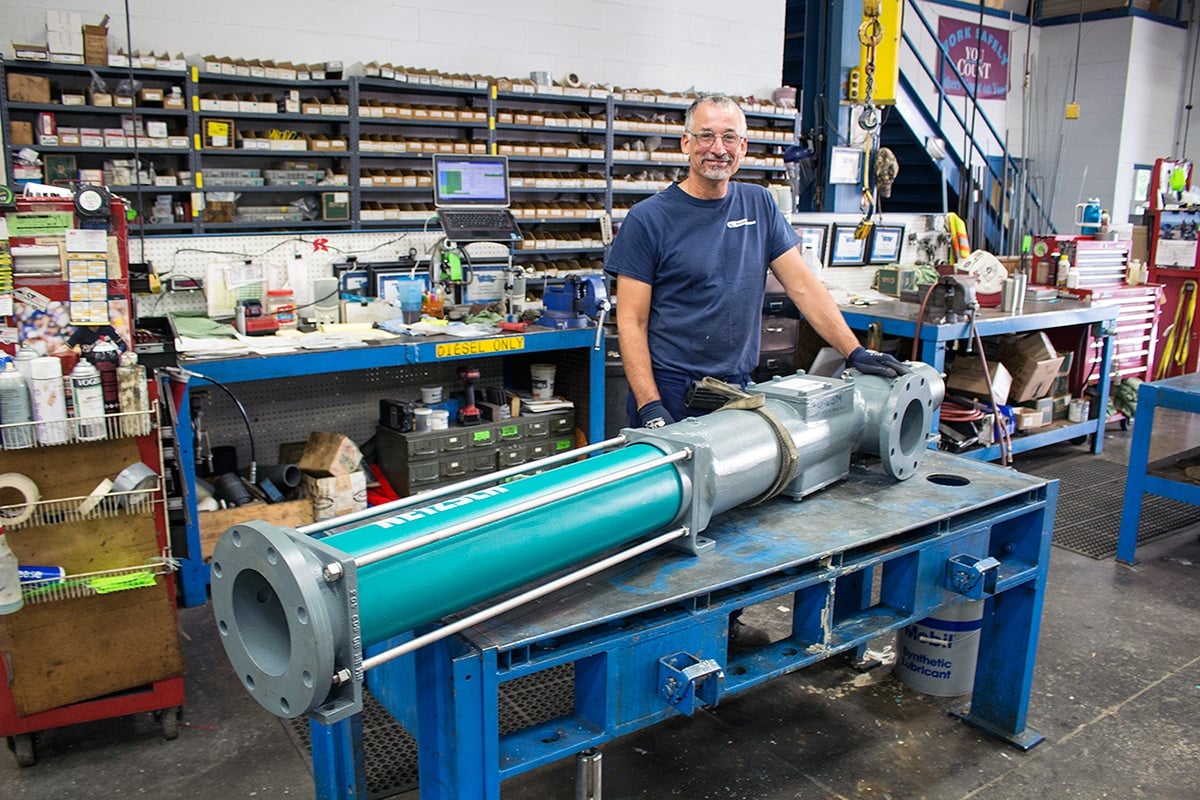


When a pump fails, the immediate priority is clear. Get it repaired. Get it back online. Restore production.
In many facilities, pump repair is treated as a transactional event. Replace worn components. Install a new rotor and stator. Swap seals. Reassemble and return the unit to service.
That approach restores operation. It does not guarantee reliability.
If your facility relies on progressive cavity pumps, rotary lobe pumps, or other positive displacement equipment, long-term performance depends on more than high-quality replacement parts. It requires understanding why the failure occurred in the first place. True pump repair should include root cause analysis, operating condition review, and application evaluation.

Standard pump repair focuses on restoring equipment to working condition. Reliability-focused pump service goes further.
A proper pump repair process should include:
However, these steps only tell part of the story. Wear patterns are symptoms. The real cause often lies in how the pump is being applied.

For example, progressive cavity pumps operating at excessive speeds can accelerate stator wear. Abrasive fluids increase rotor degradation. Inadequate suction conditions can cause cavitation or uneven loading. Dry running, even for short periods, significantly reduces stator life.
If these operating conditions are not addressed, even the best pump repair will be temporary.
Facilities often experience repeat pump repairs for the same equipment. In most cases, one or more of the following factors are involved:
1. Incorrect Operating Speed
Positive displacement pumps are designed to run within specific speed ranges. Exceeding those limits increases friction, heat, and wear.
2. Fluid Property Changes
Variations in viscosity, solids concentration, abrasiveness, or temperature can dramatically impact component life. Even small process changes can shorten maintenance intervals.
3. Inadequate Suction Conditions
Restricted suction piping, air entrainment, or insufficient net positive suction head can create uneven internal loading and performance loss.
4. Improper Material Selection
Elastomers and wetted materials must match the chemical and mechanical characteristics of the process fluid. Incorrect selections lead to swelling, cracking, or rapid wear.
5. Lack of Preventive Maintenance
Routine inspections, alignment checks, and performance monitoring are critical for early issue detection.
Addressing these factors during pump repair transforms a short-term fix into a long-term solution.
An effective pump repair strategy integrates mechanical expertise with application knowledge. This means evaluating not only what failed, but why it failed.
For facilities operating equipment such as NETZSCH progressive cavity pumps or rotary lobe pumps, service should include:
This engineering-driven approach ensures the repaired pump is not simply returned to service under the same conditions that caused the initial failure.
Frequent pump repair impacts more than maintenance budgets. It affects production uptime, labor allocation, spare parts inventory, and safety risk.
Improving reliability through application-focused service can deliver measurable benefits:
Over time, these improvements often outweigh the cost of the repair itself.
Many organizations default to reactive pump repair because it feels efficient. When something breaks, it gets fixed. But repeated failures are rarely random. Strategic pump service shifts the mindset from break-fix to performance optimization. It treats every pump repair as an opportunity to strengthen system reliability.
If your facility has experienced repeated progressive cavity pump repairs, shortened component life, or unexplained performance decline, it may be time to evaluate more than the parts inside the casing.
Pump repair should restore operation. Reliability-focused service should prevent the next failure. If you're looking to be more proactive about your equipment, reach out to our team and we'll evaluate both the equipment and the application to help you move from repeated repairs to sustained reliability.
Headquarters and Service Center
Located outside Green Bay, WI
707 Ford St,
Kimberly, WI 54136,
United States
920-733-4425
OptiFlow Design and Build Center
1002 Truman St,
Kimberly, WI 54136,
United States
920-733-4425
Burnsville Service Center
12265 Nicollet Ave,
Burnsville, MN 55337,
United States
952-444-1949
Grand Rapids Service Center
26489 Industrial Blvd,
Cohasset, MN 55721,
United States
952-444-1949