




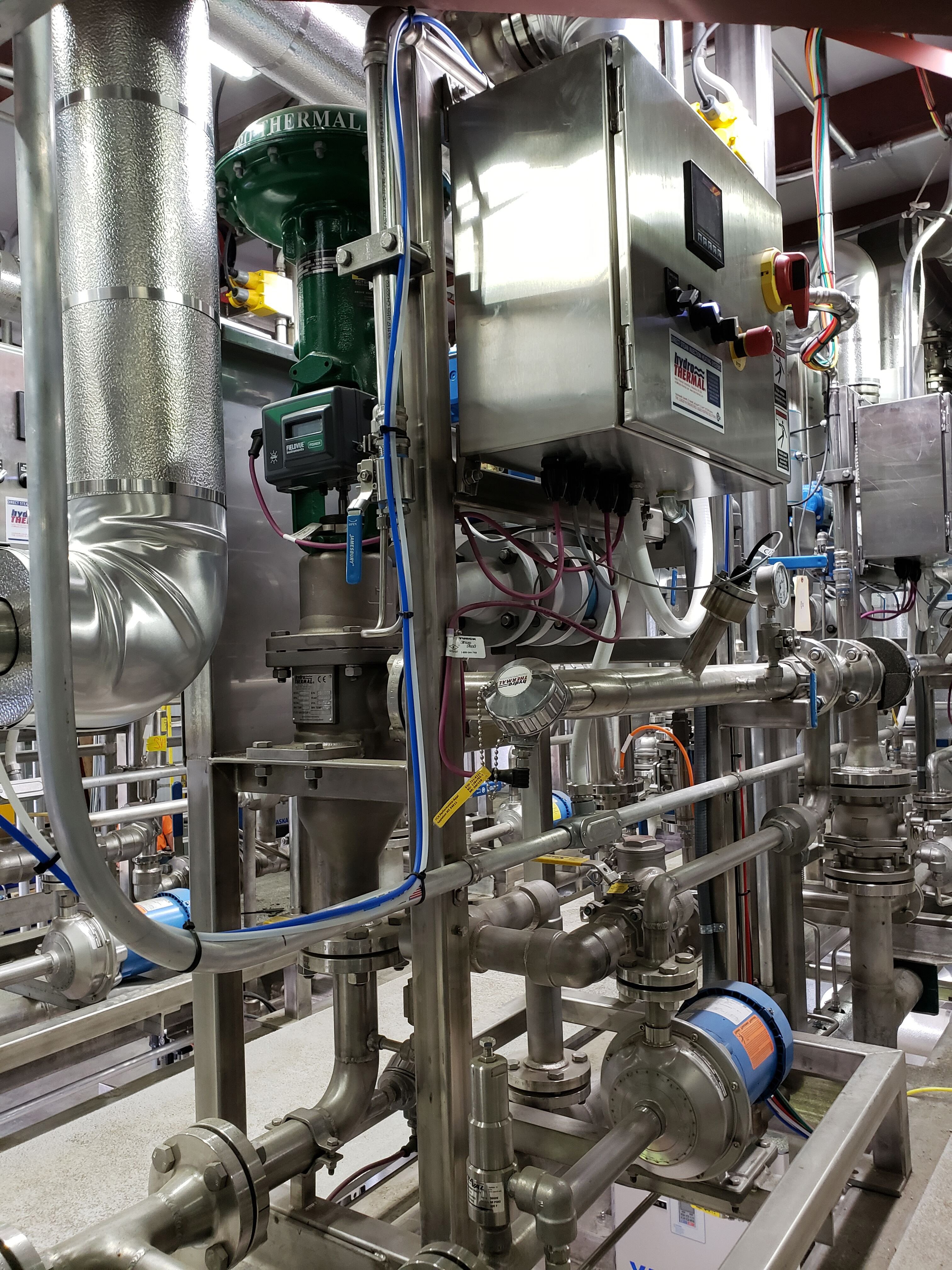


Heat exchangers are everywhere in industrial plants for a reason: when the duty is clean, low-viscosity, and steady, they work. The problems start when it is none of those things. Industrial heating sits at the unforgiving end of the spectrum, with viscous streams, particulate-laden slurries, dirty water, swing loads, and bulk volumes that have to come up fast.
Those are the duties where indirect heating quietly costs more than it should, in maintenance, in steam usage, and in lost production. They are also the duties where Direct Steam Injection (DSI) earns its keep. Five of them keep coming up.
1. Heating viscous fluids
Viscosity is the enemy of indirect heat transfer. Higher viscosity means lower film coefficients, larger exchangers, more pumping power, and faster fouling. By the time you've sized an exchanger to do the job, you've also built a maintenance problem.
DSI does not have that problem. Steam is injected directly into the fluid stream, and the mixing zone stays turbulent enough to heat heavy streams uniformly. A modulating heater like the Hydroheater® handles viscosity ranges that would push an indirect system into a much larger footprint, and it does it without a fouling surface to maintain.
2. Slurries
Slurries combine every problem indirect heating struggles with: particulates that erode and foul, density variation that upsets flow control, and the constant risk of caking on a hot surface. Plants that heat slurries through exchangers usually build a maintenance schedule around it.
DSI eliminates the hot surface entirely. The Hydroheater (and the Jetcooker™ variant used in starch and similar applications) heats slurries in a single pass, with no surface for solids to bake onto. The Solaris® Hydroheater is built for the high-temperature, high-pressure end of this duty: chemical, paper, and process slurries beyond what standard heaters can handle. Maintenance hours drop. Steam usage drops. Production hours go up.

3. Wastewater and process water heating
Wastewater is a fouling problem looking for a place to happen. Solids, biological load, scaling chemistry: every one of them is a reason an indirect heater will need cleaning. The duty cycle is rarely steady either. Wastewater loads swing with influent, which leaves oversized exchangers running well off their design point most of the time. .jpg?width=449&height=299&name=Wastewater%20(fats%2c%20oils%2c%20grease).jpg)
DSI handles both problems. No hot surface means no scaling or biofouling on the heater itself. Modulating injection means the heater turns down, and back up, smoothly across the full duty range. The EZ Heater® is the workhorse here: economical, rugged, and built for water and wastewater duty in industrial plants.
4. Rapid bulk heating
Turning a process tank around between batches, ramping up after a shutdown, answering a demand spike: when a large volume has to reach temperature now, indirect heating becomes the constraint. Heat exchangers are sized for steady state. Pushing them hard means oversized equipment, a larger steam supply, and longer dwell.%20-%20Rapid%20bulk%20heating.png?width=268&height=214&name=NOH%20(Non-Obstructing%20Heater)%20-%20Rapid%20bulk%20heating.png)
DSI is a single-pass heater. Whatever volume you can push through it, you can bring to setpoint in one pass. For plants that need large volumes hot fast, that changes the math. The Hydroheater and the NOH™ (Non-Obstructing Heater) are sized for exactly this kind of high-capacity, high-turndown duty.
5. Tank heating
Heating a tank with a steam coil is the default answer for a reason. It has been the answer for a hundred years. It is also slow, prone to fouling, hard to control precisely, and inefficient, because the coil surface is always hotter than the tank contents.
Replacing the coil with a recirculation loop through a DSI heater fixes all four problems at once. The heater is sized to bring the tank up fast. Control is tight because the heater modulates. There is no coil to foul. And steam efficiency approaches 100 percent, because the heat goes into the product rather than into the tank wall.
Where this fits in your plant 
If you are managing any of these duties (viscous heating, slurry duty, wastewater, swing loads, tank heating), DSI is worth a serious look. Crane Engineering specifies, supplies, and supports the full Hydro-Thermal industrial line: EZ Heater, Hydroheater and Jetcooker, NOH, and Solaris. We can help you evaluate whether DSI is right for the duty, size the heater, and integrate it cleanly.
Pick the heating duty in your plant that costs you the most in maintenance, downtime, or steam. We'll tell you whether DSI is right for you.
Schedule a process review with our service team!
Hydroheater®, EZ Heater®, and Solaris® are registered trademarks and Jetcooker™ and NOH™ are trademarks of Hydro-Thermal Inc. All other marks are the property of their respective owners.
Headquarters and Service Center
Located outside Green Bay, WI
707 Ford St,
Kimberly, WI 54136,
United States
920-733-4425
OptiFlow Design and Build Center
1002 Truman St,
Kimberly, WI 54136,
United States
920-733-4425
Burnsville Service Center
12265 Nicollet Ave,
Burnsville, MN 55337,
United States
952-444-1949
Grand Rapids Service Center
26489 Industrial Blvd,
Cohasset, MN 55721,
United States
952-444-1949