





In industrial operations, the right mixer can be the difference between a smooth-running process and recurring production headaches.
Too often, facilities focus first on horsepower, lead time, or replacing what’s already installed. But proper mixer selection requires a systems approach to meet your application goals.
At Crane Engineering, we help customers evaluate mixing challenges based on what’s happening inside the tank—not just what equipment was used previously. Define and understand the application goals first. Then consider mixed volume, tank geometry, fluid properties, solids content, viscosity, and overall blend time requirements to optimize your mixer and tank pairing.
That’s why selecting the right solution starts with defining the goals and understanding the process parameters.
Tank size and more precisely, mixed volume is the first and most important consideration in mixer selection. Next, evaluate the intended vessel’s diameter, height and the liquid level compared to the tank diameter. Narrower diameter vessels with relatively tall straight sides, tend to require more impellers and stronger support structures than wider vessels of the same volume capacity.
Agitator designs that work well in 500 gallon low viscosity applications may fail to meet the process goals in a 250 gallon, medium viscosity batch. Similarly, impellers that meet a blending goal, may not necessarily work well in a solids suspension process. 
At Crane Engineering, we typically help customers think in three categories:
These are often found in:
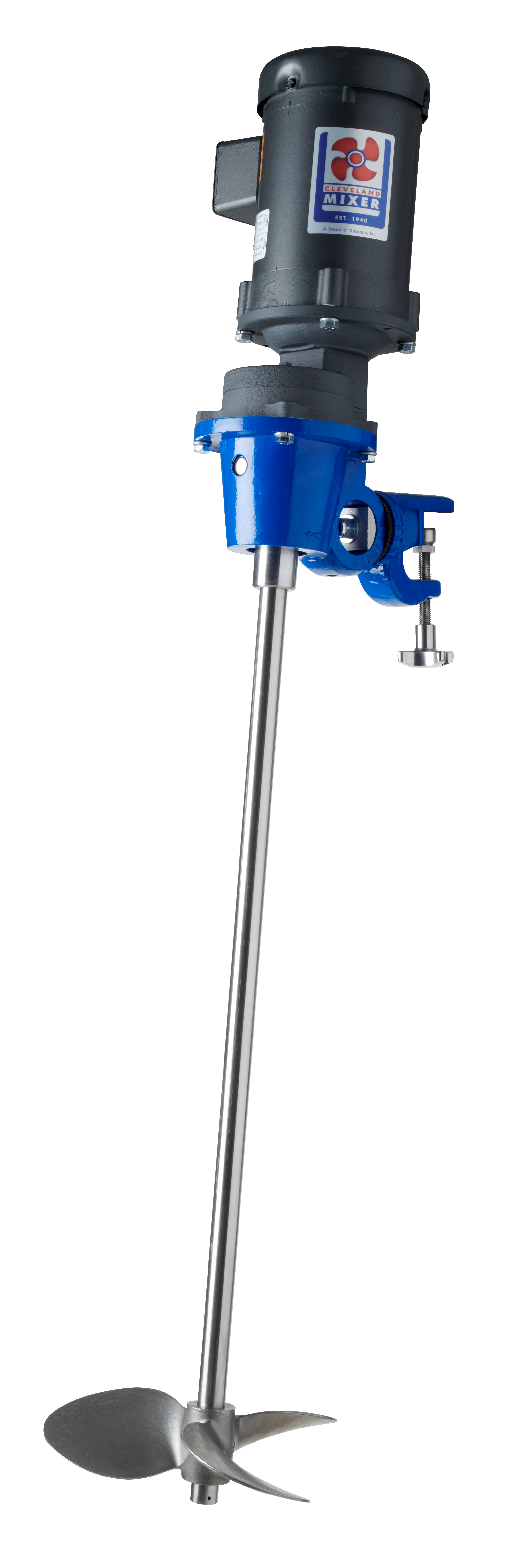
For tanks in this range, Cleveland’s CG Series Portable Gear Driven Clamp Mixer is often a strong fit. It is designed specifically for 50 to 750 gallon tanks and moderate mixing intensity requirements. The sealed-for-life helical gear reducer and heavy-duty, impeller shaft support bearings help provide long service life in demanding industrial environments.
This type of mixer is ideal when customers need portability, flexibility, or smaller batch processing.

A wastewater facility needs to blend polymer solution in a 300-gallon batch tank. The current mixer is a low-cost direct drive unit whose propeller diameter spins too fast and shears the polymer and leads to inconsistent batch quality.
In this case, Crane may recommend a gear-driven clamp mixer like the CG Series to invest more torque by virtue of its lower speed and larger diameter impeller. The result, similar energy consumption but consistently excellent batch quality with reduced processing time.

This is one of the most common ranges we see across industrial operations.
Typical applications include:
For this range, Cleveland’s FRG Series Portable Fixed Mount Gear Driven Mixer is a robust and effective option with a multitude of options to meet the process demands.
The FRG is designed specifically for 500 to 5,000 gallon applications and offers flexibility in horsepower, output speeds, impeller configurations and flange mounting. It is designed around your application needs with the impeller(s) optimized to the tank dimensions for a given mixed volume.
Impellers are selected based on the process category such as solids suspension, blending, heat transfer, shear imposition, etc... essentially they accomplish mixing goals according to their response in a range of Impeller Reynolds Numbers (Inertia forces vs. viscous forces.) To accomplish the mixing goals, the impeller has the determinative role.
A chemical processor is blending additives in a 2,500-gallon tank and seeing inconsistent blending quality leading them to think that a higher horsepower motor might be required. The issue may not be the motor power at all.
Instead, the problem could be:
This is where Crane’s application expertise becomes most valuable. Rather than simply replacing the existing unit with a larger motor, we help customers evaluate the process to ensure the new equipment solves the root issue.
Once liquid depth (beyond 120”) or volume exceeds portable and fixed entry mixer capacity, the equipment requirements change significantly.
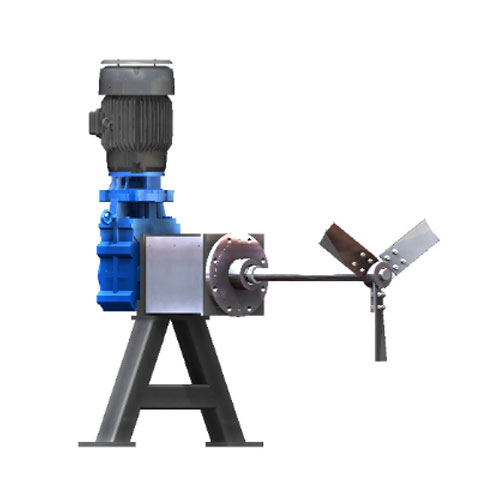
For these situations, Cleveland Mixer’s RXT is the correct solution. Scalable from 5,000 gallons to 500,000 gallons, the RXT Series is specifically designed for low head room applications and large production mixed volumes. 
These mixers are ideal when the process requires:
The right angle, robust gear reducer is designed for mixer service with oversized bearings to handle high radial and axial loads; and an available dry well. Minimum bearing life is 50,000 hours of L10 life.
A pulp and paper plant is blending slurry in a deep process tank. Their current portable mixer cannot maintain uniform solids suspension through the full tank depth.
In this case, Crane may recommend stepping up to a right-angle mixer like the RXT Series to increase mixing intensity to prevent inconsistent pulp density.
Tank size alone does not determine the right mixer. The actual process conditions are equally important. At Crane Engineering, we often help customers evaluate:
Thin fluids require a different mixing strategy than slurries or fluids with non-Newtonian characteristics.
Are you blending powders into liquid?
Keeping solids suspended in uniformity?
Preventing settling?
Some applications need gentle stirring.
Others require aggressive shear and turnover.
Diameter-to-height ratio matters. A tall narrow tank may require two or more impellers and of different geometry than the same volume in a wider, shorter vessel.
Improper or missing baffles can create vortexing and poor blend consistency. These are often overlooked but dramatically affect mixing results.
Some of the most common issues we help solve include:
Many customers simply replace an old mixer with the same model. But if the old unit underperformed, this repeats the problem.
Sometimes a lower-cost, faster-shipping unit is selected without considering process needs. This can cause process failure, wasted batches or incur long-term downtime.
A mixer sized for today’s batch size may struggle as production volumes increase. Crane helps customers think ahead with proper scale up procedures.
Choosing the right mixer is rarely just a product decision. It’s an application decision. That’s why customers rely on Crane Engineering as a trusted advisor. We help evaluate:
Then we align those needs with trusted products from Cleveland Mixer and other leading manufacturers.
Cleveland Mixer offers one of the most comprehensive liquid mixing lines available, supporting tanks from 5 gallons up to 500,000 gallons and beyond.
But the real value comes from applying the right solution the first time. That’s where Crane helps plants reduce downtime, improve process consistency, and make better long-term capital decisions.

Headquarters and Service Center
Located outside Green Bay, WI
707 Ford St,
Kimberly, WI 54136,
United States
920-733-4425
OptiFlow Design and Build Center
1002 Truman St,
Kimberly, WI 54136,
United States
920-733-4425
Burnsville Service Center
12265 Nicollet Ave,
Burnsville, MN 55337,
United States
952-444-1949
Grand Rapids Service Center
26489 Industrial Blvd,
Cohasset, MN 55721,
United States
952-444-1949