




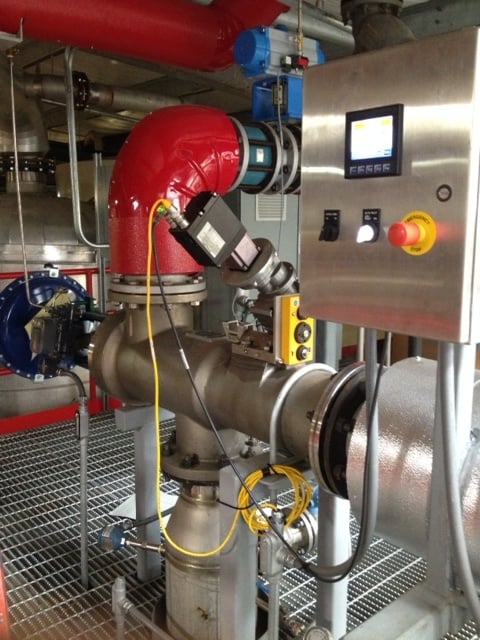


Walk through a food or beverage plant and you'll find heat being added in half a dozen different places, for half a dozen different reasons. CIP supply, ingredient prep, starch cooking, hot fill, process water on demand. The temperatures are different, the duty cycles are different, the cleanability requirements are different. The one thing they have in common: getting the heating wrong shows up in product quality, sanitation, throughput, or all three.
Direct Steam Injection isn't the right answer for every heating job in an F&B plant. But there are five applications where DSI consistently outperforms indirect heating, often by a wide margin. These are the ones to look at first.
1. Clean-in-place (CIP) supply
CIP is heat-up time turned into operating cost. Every minute waiting for caustic to come up to temperature is a minute the line isn't producing. Worse, indirect CIP heaters routinely drift — cycle to cycle, the supply temperature isn't quite the same, and the validation paperwork either gets fudged or the cycle gets extended.
A sanitary DSI heater like the Hydro-Thermal Silverline or Hydron heats CIP solution on demand, in a single pass, to a setpoint held within roughly ±1 °F. The cycle is shorter, the temperature is documented, and the heater itself is CIP-able. Plants that switch typically reclaim 10–30% of their CIP cycle time, which goes directly back to production.
2. Starch and slurry heating
Starch is a common application for DSI. Every starch processor knows what happens when you push slurry past a hot exchanger surface: it gels, it sticks, it carbonizes, and you're tearing down to clean within the week. The Hydroheater Jetcooker exists because the people building it spent years inside starch plants watching exchangers fail.
DSI heats the slurry from the inside out, in a turbulent injection zone, with no hot surface for the starch to interact with. Gelatinization is uniform, the product comes out at exactly the temperature you want, and the maintenance schedule on the heater itself disappears. The same principle applies to fruit preps, protein slurries, and other particulate-laden streams — the Infuze line is built specifically for high-viscosity and particulate-bearing applications.

3. Ingredient batching
Batch makers live and die on repeatability. When the recipe calls for water at 165 °F, it needs to be 165 °F every time — not 162 °F at the start of shift and 170 °F when the boiler load shifts. Indirect heaters carry too much thermal mass to respond to demand the way a modulating DSI heater can.
A DSI heater modulates steam injection in real time based on flow and temperature. Setpoint changes are essentially instantaneous. For batch operations running multiple recipes through the same heating system, this turns into shorter changeovers and tighter batch-to-batch consistency — the kind of consistency that shows up in QA logs and customer complaints.
4. Process water on demand
Most plants size their hot water systems for peak demand and then pay to keep that capacity hot all day. Storage tanks lose energy through the walls. Recirculation lines lose energy through the piping. The water at the use point is usually a few degrees off from where it was supposed to be.
DSI flips this. You generate hot water when and where you need it, in the volume you need, at the temperature you need. Tank-based hot water systems shrink or disappear. Energy use drops. The water at the use point is the temperature the heater was set to, because it just left the heater.
5. Temperature-sensitive products
Dairy. Egg products. Anything with denaturable proteins. Anything where the difference between 180 °F and 185 °F is the difference between in-spec and a write-off.
Indirect heating fights this on two fronts: the hot surface temperature is always higher than the target product temperature, so localized scorching is a constant risk; and the control loop is slow enough that overshoot is normal. DSI runs the steam itself as the heating medium, with no hot wall, and modulates fast enough to land on setpoint without overshoot. For temperature-sensitive products, that's not a nice-to-have — it's the whole job.
What this looks like in your plant
If one or more of these applications sounds like a problem you're already solving (or working around), DSI is worth a conversation. Crane Engineering specifies, supplies, and supports the full Hydro-Thermal sanitary line — Hydron, Infuze, Silverline — and we work the process review with you, not at you.
Tell us about one heating headache in your plant. We'll tell you straight whether DSI helps or not — and if it does, what the right heater for the application would be. Schedule a 20-minute call at HERE.
Headquarters and Service Center
Located outside Green Bay, WI
707 Ford St,
Kimberly, WI 54136,
United States
920-733-4425
OptiFlow Design and Build Center
1002 Truman St,
Kimberly, WI 54136,
United States
920-733-4425
Burnsville Service Center
12265 Nicollet Ave,
Burnsville, MN 55337,
United States
952-444-1949
Grand Rapids Service Center
26489 Industrial Blvd,
Cohasset, MN 55721,
United States
952-444-1949